
RETON Ring Mesh Co., Ltd.A Professional, Reliable And Experienced Metal Products Manufacturer
+86-18632192156 sales@rt-ringmesh.com

In high-risk industries such as meat processing, glass manufacturing, and textile cutting, hand injuries remain one of the most common occupational hazards. Chainmail gloves, with their exceptional cut resistance, continue to be the preferred personal protective equipment for professionals worldwide. This comprehensive guide explores how to select the best chainmail gloves, examining industry standards, material analysis, and maintenance techniques. The information presented draws from the expertise of professional manufacturer RETON RING MESH CO., LTD. , a leading China factory specializing in metal mesh protection solutions. For specific product inquiries, you can reach them via E-Mail: sales@rt-ringmesh.com or WhatsApp: +8618632192156.
What Are Chainmail Gloves? Working Principles and Technical Advantages
Core Material Analysis: Choosing the Right Stainless Steel Gloves
Technical Standards and Safety Certifications
How to Determine the Correct Size and Fit
Industry Applications and Solutions
Maintenance and Care: Extending Glove Lifespan
Frequently Asked Questions
Conclusion: Choosing a Reliable China Supplier
Chainmail gloves are constructed from thousands of individual stainless steel rings, each welded or riveted together to form a flexible metal protective layer. This unique structure effectively disperses the cutting force of blades, preventing direct contact with the skin. Unlike standard cut-resistant gloves made from synthetic materials, chainmail gloves are specifically designed for high-risk cutting environments such as slaughterhouses, butchering operations, and handling sharp glass.
How They Work:
The interlocking ring system creates a physical barrier that blades cannot penetrate. When a knife makes contact, the force is distributed across multiple rings rather than concentrating at a single point. This principle, combined with the hardness of stainless steel, provides superior protection against accidental cuts.
According to RETON RING MESH CO., LTD. , a reputable China manufacturer with years of industry experience, high-quality gloves are typically manufactured using imported machinery and equipment to ensure each ring's welding point is uniform and secure. This manufacturing precision is what separates reliable protective equipment from substandard alternatives. These gloves not only provide reliable protection but also prioritize wearing comfort, flexibility, and durability – essential factors for workers who wear them throughout lengthy shifts.
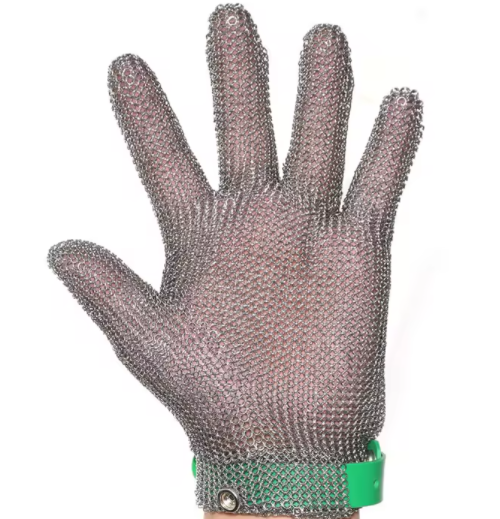
Chainmail Gloves
When selecting chainmail gloves, the material composition is the critical factor determining performance. While various metals exist in the market, stainless steel dominates due to its comprehensive properties. Below is a detailed comparison of different materials commonly used by Chinese suppliers and factories:
| Material Type | Advantages | Limitations | Best Application Scenarios |
|---|---|---|---|
| Stainless Steel | High corrosion resistance, hygienic and easy to clean, meets food industry standards, excellent cut resistance levels | Relatively heavy (depends on ring diameter), higher cost | Wet environments, food processing, seafood handling, commercial kitchens |
| Carbon Steel | Exceptional cut and abrasion resistance, high strength, cost-effective | Prone to rust, requires regular oiling maintenance, unsuitable for humid environments | Dry industrial settings, metal fabrication, recycling operations |
| Alloy Steel | Balanced strength and flexibility, enhanced durability | Higher price than standard carbon steel, still vulnerable to moisture | Glass handling, automotive assembly, precision metalwork |
For most commercial kitchens and food processing facilities, stainless steel chainmail gloves represent the optimal choice. This material not only meets strict hygiene regulations such as HACCP and FDA guidelines but also ensures long service life through frequent washing cycles. The corrosion resistance characteristic is particularly valuable in environments where gloves come into contact with acids, salts, and cleaning agents daily.
Ring Diameter Considerations:
Professional China factory suppliers like RETON offer various ring diameters to suit different applications:
Small diameter (4.2mm): Provides denser protection for extreme cutting risks
Medium diameter (5.0mm): Balanced protection and weight for general use
Large diameter (6.0mm): Lighter weight for lower-risk applications
A professional pair of chainmail gloves must comply with international safety standards. Understanding these certifications is crucial when evaluating suppliers:
In the European market, protective gloves must meet the EN 388 standard, which uses four numbers (abrasion, cut, tear, puncture) to indicate mechanical risk protection levels. Chainmail gloves typically excel in cut resistance performance. It's important to note that the revised EN 388:2016 standard introduced ISO 13997 (TDM test) to evaluate cut resistance against blunt blades, measured in Newtons (N) with grades ranging from A to F.
This international standard specifically addresses protective chainmail gloves and arm guards used when handling hand knives to prevent cuts and stab wounds. It specifies requirements for design, penetration resistance, ergonomics, fastening systems, weight, materials, and marking. Products conforming to ISO 13999-1:1999 are designed with the specific risks of industries like meat processing in mind.
RETON RING MESH CO., LTD. , as a professional China supplier, ensures its products have obtained European CE certification. This demonstrates compliance with EU safety, health, and environmental requirements, making their products competitive in international markets. When sourcing from a China factory, always request documentation of these certifications.
Chainmail gloves must fit properly to provide maximum protection. Loose gloves compromise dexterity and may even slip off, while tight gloves restrict blood circulation, causing hand fatigue during extended wear.
Measurement Method:
Measure the circumference of your palm (excluding the thumb) around the widest part—typically the knuckles. To ensure wearing comfort, add 5mm to your measurement. If you plan to wear cotton liner gloves underneath (highly recommended for hygiene and comfort), add an additional 3mm allowance.
Size Reference Chart:
| Size | Color Code | Palm Circumference Reference | Total Length Reference (+/- 8mm) |
|---|---|---|---|
| XXS (Extra Extra Small) | Brown | Approximately 18.8 cm | 188mm |
| XS (Extra Small) | Green | Approximately 20.0 cm | 200mm |
| S (Small) | White | Approximately 21.2 cm | 212mm |
| M (Medium) | Red | Approximately 22.5 cm | 225mm |
| L (Large) | Blue | Approximately 23.7 cm | 237mm |
| XL (Extra Large) | Orange | Approximately 25.0 cm | 250mm |
Many manufacturers, including RETON RING MESH CO., LTD. , incorporate color-coded wrist bands. This design not only increases durability but also facilitates easy size identification. Gloves are typically designed as ambidextrous (usable on either hand) and come equipped with tensioners or tightening systems to ensure a secure fit around the wrist.
The application range of chainmail gloves extends far beyond traditional uses. Here are several typical industry applications where RETON RING MESH CO., LTD. products demonstrate versatility:
Meat Processing and Slaughterhouses:
This remains the most traditional application. When workers use knives to portion carcasses, the non-knife hand wearing a chainmail glove provides defense against accidental cuts. For extreme cutting risks involving exceptionally sharp blades, gloves with smaller ring diameters (such as 4.2mm) are recommended to provide denser protection.
Seafood and Food Processing:
When shucking oysters, filleting fish, or handling shellfish, chainmail gloves protect against both knife cuts and puncture wounds from sharp shells. Their easy-to-clean characteristic is crucial in environments requiring frequent washing and sanitation.
Glass and Metal Fabrication:
When handling large glass sheets or sharp metal edges, chainmail gloves prevent severe lacerations caused by material breakage or sharp burrs. Workers in automotive glass installation and architectural glazing particularly benefit from this protection.
Textile Cutting:
In garment factories using fabric cutting machines, operators wearing chainmail gloves protect their hands from high-speed rotating blades. This application demonstrates how traditional protection methods adapt to modern manufacturing needs.
Recycling and Waste Management:
Workers sorting through recyclable materials face constant risks from hidden sharp objects. Chainmail gloves provide reliable protection against unexpected cuts from broken glass, metal scraps, or other hazardous items.
Proper maintenance not only extends glove lifespan but also ensures consistent protective performance. Damaged or corroded rings significantly compromise safety.
Immediate Cleaning: Clean gloves immediately after use. For food industry applications, use warm water (approximately 50°C) and food-grade industrial cleaners. Scrub vigorously with a hard brush to remove all residues.
Mechanical Washing: Chainmail gloves can be placed in standard industrial washing machines—this proves highly effective for thorough cleaning.
Disinfection and Drying: After cleaning, allow products to dry completely, then spray with food-grade disinfectants and let stand for several minutes. Avoid disinfectants containing excessive chlorine or acid, as these may damage the metal. Thorough air drying is essential before storage in dry, cool, ventilated areas to prevent potential rust spots even on stainless steel.
Pre-use Inspection: Before each use, check for broken rings or deformed areas. Any gloves showing abnormal wear or missing rings must be removed from service immediately.
Professional Repair: Repairs must use original manufacturer parts—only original components ensure the glove maintains its CE-certified protection level. Professional manufacturers provide authorized repair services. For RETON products, contact their after-sales service for professional support.
Store gloves hanging or laid flat, never folded or crushed
Keep away from corrosive chemicals
Maintain in dry environments with moderate temperature
Regular inspection even during storage periods
When selecting and using chainmail gloves, users commonly encounter these questions. Based on industry knowledge and expertise from professional China suppliers, here are comprehensive answers:
Q1: Can chainmail gloves protect against all types of injuries?
A: No. Chainmail gloves are primarily designed for cut and stab resistance (specifically against hand knives). They cannot protect against crushing injuries, entanglement with moving machine parts, electrical shocks, or impact damage. Never wear chainmail gloves when operating rotating saws or electric slicers, as the gloves may be caught and pulled in, causing severe injuries.
Q2: Which hand should I wear the chainmail glove on?
A: According to safety protocols, chainmail gloves should be worn on the non-knife hand. For example, if you are right-handed and hold the knife in your right hand, wear the glove on your left hand. This hand typically holds the material being cut and remains closest to the blade's path.
Q3: Can chainmail gloves be washed in dishwashers?
A: While they can be washed with water, household dishwashers are not recommended. The high-temperature, high-pressure cycles are not designed for metal protective equipment, and dishwasher detergents may contain chemicals corrosive to metal. Hand washing with warm water and soft brushes, or using industrial washing machines, remains the preferred method.
Q4: How do I know when to replace my gloves?
A: Immediate replacement is required when any of the following occurs: one or more rings are broken or de-welded; significant deformation affects proper fit; surface corrosion or contamination cannot be removed; professional repair cannot restore structural integrity.
Q5: Can your company (RETON) provide custom solutions?
A: Yes, as a professional China manufacturer, RETON RING MESH CO., LTD. can provide customized solutions based on customer requirements to meet specific working environment needs. Custom options may include different lengths, integrated arm guards, or specialized ring configurations. Inquiries can be directed to E-Mail: sales@rt-ringmesh.com.
Q6: Are these gloves suitable for left-handed users?
A: Most chainmail gloves are designed as ambidextrous, suitable for both hands. However, some specialized models may be hand-specific. Consult with your supplier to confirm suitability for your specific application.
Q7: What quality control measures do Chinese factories implement?
A: Reputable China factory suppliers like RETON RING MESH CO., LTD. implement rigorous quality control including ring welding inspection, tensile strength testing, dimensional verification, and final visual inspection before packaging. CE certification requires documented quality procedures.
Finding the best chainmail gloves involves more than simply purchasing protective equipment—it represents an investment in employee safety and operational continuity. From meat processing to glass manufacturing, high-quality chainmail gloves must balance safety, flexibility, and durability.
As a professional manufacturer in this field, RETON RING MESH CO., LTD. combines advanced production equipment, CE-certified manufacturing processes, and deep understanding of customer requirements to provide reliable protection solutions to users worldwide. Whether you need standard five-finger gloves or extended-length models with forearm protection, selecting the right supplier is crucial.
When evaluating potential China factory partners, consider these factors:
Certification Documentation: Request copies of CE, ISO, and other relevant certifications
Sample Evaluation: Test gloves in your actual working environment
After-sales Support: Confirm repair services and spare parts availability
Customization Capabilities: Discuss specific requirements for your industry
Lead Times: Understand production and shipping timelines
Before making procurement decisions, verify product specifications, certification standards, and the supplier's after-sales service capabilities. For detailed product information or professional recommendations, contact RETON RING MESH CO., LTD. directly:
E-Mail: sales@rt-ringmesh.com
WhatsApp: +8618632192156
Choose the right chainmail gloves and make safety an integral part of your daily operations. With the right protective equipment from a trusted China supplier, you protect not only hands but also productivity, morale, and business continuity.
Processing Demand Survey