
RETON Ring Mesh Co., Ltd.A Professional, Reliable And Experienced Metal Products Manufacturer
+86-18632192156 sales@rt-ringmesh.com

Introduction
The global meat processing industry requires consistent, reliable hand protection to address occupational hazards associated with sharp tools and demanding environments. China has become a central hub in the manufacturing of specialized butcher gloves, ranging from traditional chainmail to advanced composite materials. This article provides a technical overview of the product categories, industry standards, and manufacturing capabilities within this sector, with specific reference to the products and practices of the RETON brand. The focus is on material specifications, performance data, and the integration of quality control within the supply chain.
1. Industry Landscape and Product Categorization
China's manufacturing sector produces a comprehensive range of butcher gloves, categorized primarily by their protective mechanism and materials.
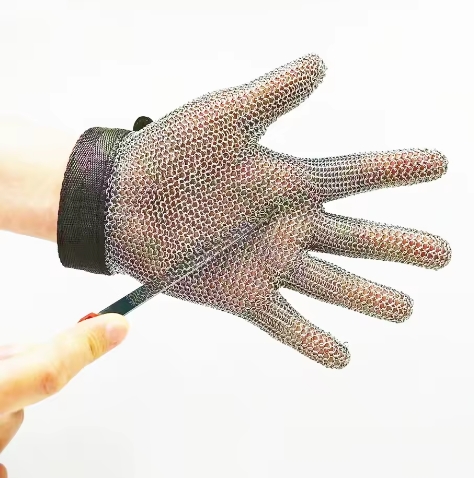
Stainless Steel Chainmail Gloves: These remain the benchmark for high-pressure cut and puncture resistance. Key specifications from Chinese manufacturers typically involve AISI 304 or 316L stainless steel, with ring inner diameters of 6-8mm and wire diameters of 0.8mm-1.0mm. The 4-in-1 weave pattern is standard for optimal flexibility and strength.
High-Performance Fiber Gloves: Gloves made from materials like Ultra-High Molecular Weight Polyethylene (UHMWPE), Aramid, and fiberglass composites are widely produced. They are rated according to international standards (e.g., EN 388:2016, ANSI/ISEA 105) for cut resistance (Levels A1-A9 or 1-5), offering lighter weight and greater dexterity for tasks with lower direct puncture risk.
Hybrid and Composite Gloves: This category represents significant technical development, combining a stainless steel mesh (often on the back of the hand or fingers) with seamless knit high-cut-resistant fiber palms. This design aims to balance overall protection with grip and comfort.
2. Material Science and Performance Benchmarks
Performance is directly tied to material properties and construction quality.
Chainmail Metallurgy: For brands like RETON, the use of 316L stainless steel (containing 2-3% Molybdenum) is common for applications requiring frequent chemical sterilization, as it offers superior pitting resistance. Standard industry testing involves practical cut tests with boning knives and puncture tests using conical probes. Data indicates that a quality 1.0mm diameter wire mesh can withstand puncture forces exceeding 150 Newtons.
Fiber Technology: Cut resistance in fiber gloves is measured via the ISO 13997 (Tommy Blade) test. Gloves incorporating UHMWPE fibers can achieve cut ratings of Level 5 (ANSI) or A4-A6 (EN), corresponding to a cutting index between 10 and 30 Newtons. RETON and other manufacturers provide Technical Data Sheets detailing these standardized test results for each product line.
Ergonomics and Grip: Grip performance is quantified through tests like the ASTM F2913 Standard Test Method for Measuring Coefficient of Friction. Polymer coatings (e.g., nitrile, polyurethane) are applied to fiber gloves in specific patterns to enhance wet and oily grip, with coefficient of friction values typically ranging from 0.8 to 1.4 under controlled conditions.
3. Manufacturing Standards and Quality Assurance
The reputation of Chinese manufacturers is built on adherence to international standards and robust quality control systems.
Compliance Frameworks: Leading brands ensure their products conform to relevant PPE directives (EU PPE Regulation 2016/425) and food safety regulations (e.g., FDA 21 CFR for food-contact materials, EU Regulation (EC) No 1935/2004). Certification from bodies like SGS or Intertek is common.
Quality Control Processes: A comprehensive QC protocol involves:
Incoming material inspection (wire/fiber tensile strength, composition).
In-process checks (weave density, coating uniformity, seam strength).
Final product batch testing against claimed performance levels.
The RETON brand, for instance, implements such multi-stage inspections to ensure batch-to-batch consistency, a critical factor for industrial clients.
4. Supply Chain and Market Considerations
China's integrated supply chain for raw materials (stainless steel, synthetic fibers) and mature manufacturing infrastructure enable scalable production and cost efficiency.
Specialization: Many factories specialize in specific product types, allowing for deep technical expertise. RETON operates with dedicated production lines for metal mesh weaving and for high-tech fiber knitting and coating, ensuring process optimization.
Export-Oriented Design: Products are often designed to meet the specific regulatory and practical requirements of key export markets in North America, Europe, and Asia-Pacific. This includes size grading (US vs. EU sizing), cuff length preferences, and compliance labeling.
5. The RETON Brand: A Case Study in Integrated Manufacturing
The RETON brand exemplifies the technical capabilities within the Chinese industry. Its product portfolio demonstrates an application-focused approach:
Product Segmentation: RETON offers distinct series:
Chainmail Series (e.g., RM-Series): Specified for AISI 316L, with options for fine (6mm I.D.) or standard (8mm I.D.) mesh, paired with either absorbent or cut-resistant liners.
Fiber Composite Series (e.g., RF-Series): Gloves engineered with UHMWPE and other fibers, achieving EN 388 Cut Levels up to F, combined with abrasion-resistant and grippy coatings.
Data-Driven Specifications: Product documentation provides clear data on wire gauge, fiber composition, cut and puncture ratings, and sizing. This transparency allows safety managers to conduct precise risk assessments and select appropriate gloves for specific tasks.
Commitment to Consistency: By controlling key stages of production and enforcing strict QC checkpoints, RETON aims to deliver predictable performance, which is a primary requirement for professional food processing operations globally.
Conclusion
The Chinese butcher gloves industry provides a diverse and technically advanced array of products for global markets. Its strength lies in manufacturing scale, material accessibility, and an increasing focus on quality compliance and data-backed performance. Brands like RETON illustrate the sector's evolution from basic manufacturing to offering specialized, specification-driven safety solutions. For buyers, the key remains in carefully evaluating technical data sheets, verifying independent certifications, and selecting products that are correctly specified for the intended tasks and regulatory environment.
References
European Committee for Standardization (CEN). (2016). *EN 388:2016 - Protective gloves against mechanical risks.*
American National Standards Institute / International Safety Equipment Association (ANSI/ISEA). (2016). *ANSI/ISEA 105-2016 - Hand Protection Classification.*
International Organization for Standardization (ISO). (1999). *ISO 13997:1999 - Protective clothing — Mechanical properties — Determination of resistance to cutting by sharp objects.*
U.S. Food and Drug Administration. Code of Federal Regulations Title 21, Part 177 – Indirect Food Additives: Polymers.
European Parliament and Council. (2004). *Regulation (EC) No 1935/2004 on materials and articles intended to come into contact with food.*
RETON Brand. (2023). Product Technical Data Sheets: RM-Series Chainmail Gloves & RF-Series Cut-Resistant Gloves. [Manufacturer's Documentation].
ASTM International. (2011). *ASTM F2913-11 Standard Test Method for Measuring the Coefficient of Friction for Evaluation of Slip Performance of Footwear and Test Surfaces/Flooring Using a Whole Shoe Tester.*
Processing Demand Survey