
RETON Ring Mesh Co., Ltd.A Professional, Reliable And Experienced Metal Products Manufacturer
+86-18632192156 sales@rt-ringmesh.com

Chainmail gloves, a specialized form of hand protection with historical origins, have evolved into a critical piece of Personal Protective Equipment (PPE) in modern industry. Their unique construction offers a blend of cut resistance, durability, and dexterity not easily matched by other materials. This article provides a detailed, data-informed examination of chainmail glove manufacturing, with specific attention to the production processes, technical standards, and application areas associated with the RETON brand.
Chainmail gloves are constructed from a matrix of interlocking metal rings. Unlike knitted or woven textiles, this matrix is assembled through a precise linking process, creating a flexible yet highly resistant barrier. The manufacturing cycle for a brand like RETON typically follows these key stages:
Material Selection and Wire Drawing: The process begins with high-grade stainless steel, most commonly Type 304 (A2) or Type 316 (A4). Type 316 offers enhanced resistance to chlorides and acids, making it suitable for food processing and chemical environments. The steel is drawn into wire with a precise diameter, typically ranging from 0.6mm to 0.9mm for standard industrial gloves. This diameter is a primary factor in determining the glove's weight and protective level.
Ring Formation and Closure: The wire is coiled and cut to form individual rings. The method of ring closure is a critical differentiator in quality. RETON gloves predominantly utilize riveted or welded closures. In riveted construction, the ends of the ring are overlapped and pierced with a small rivet, preventing the ring from opening under force. Welded rings are fused at the joint. Both methods are superior to butted rings (where the ends simply meet), which can separate upon impact.
Weaving and Assembly: The closed rings are woven into a predetermined pattern, traditionally the European 4-in-1 pattern (where each ring links through four others). This pattern offers an optimal balance of flexibility, coverage, and strength. The weaving is done to form a flat mesh, which is then shaped and tailored into a glove pattern. Seams are reinforced with heavier-gauge rings or specialized stitching.
Finishing and Quality Control: The assembled glove undergoes a multi-stage finishing process. This includes tumbling to smooth any rough edges, passivation (for stainless steel) to enhance corrosion resistance, and thorough cleaning. Each glove is subject to visual and tactile inspection for consistent ring density, secure closures, and proper sizing. Statistical process control is often employed, with manufacturers sampling a percentage of each production batch for dimensional checks.
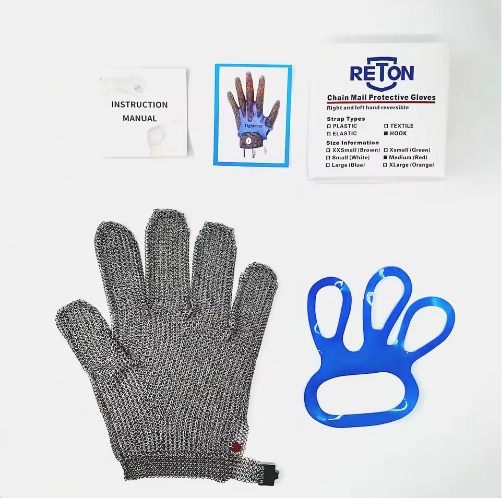
Performance is measured against rigorous international standards, which provide objective data for comparison. Key standards include:
EN 1082-1 & EN ISO 13997: These are the most relevant standards for assessing protection against cuts by sharp objects like knives. The EN ISO 13997 test, in particular, measures the load (in Newtons) required for a sharp blade to cut through the material at a standard distance. High-performance chainmail gloves can achieve cut resistance levels exceeding 10 Newtons under this test, often placing them in Level 4 or 5 of the EN 388:2016 scale for blade cut resistance.
EN 388:2016: This broader standard for protective gloves includes tests for abrasion, blade cut (Coup Test), tear, and puncture. While chainmail excels in blade cut resistance, its performance in abrasion (Martindale test) and puncture is also quantified. For example, a standard stainless steel mesh may achieve an Abrasion Resistance rating of 2 (1,000 cycles) and a Puncture Resistance of 3 (100 Newtons).
Material Composition Certification: Reputable factories provide material certificates, such as a Mill Certificate for stainless steel, verifying the alloy composition (e.g., 18% Chromium, 8% Nickel for 304 SS). This is crucial for applications requiring corrosion resistance or compliance with food contact regulations (e.g., EU Regulation 1935/2004/EC).
The use of chainmail gloves is dictated by specific hazard analyses. They are not general-purpose gloves but are deployed in sectors where sharp-edged tools or materials present a primary risk.
Meat, Poultry, and Fish Processing: This is the largest application sector. The gloves protect workers using sharp knives for boning, filleting, and trimming. According to industry data from the U.S. Bureau of Labor Statistics, slaughterhouse and meat packing workers have a nonfatal injury rate significantly higher than the national average for all industries, with lacerations being a predominant type. The cleanability and corrosion resistance of stainless steel are essential here.
Glass and Metal Fabrication: Workers handling sheet glass, sharp metal blanks, or stamped components use chainmail to prevent severe lacerations. The glove's ability to deflect a slicing motion is its key function.
Automotive and Aerospace: Specific assembly tasks, particularly involving composite materials (e.g., carbon fiber) or sharp-edged trim, may require this protection.
Security and Law Enforcement: Used in corrections facilities or during searches where needles or handmade weapons are a concern.
The RETON brand represents a focused manufacturing operation within this specialized field. The brand's positioning is built on several observable factors:
Focus on Core Materials: RETON gloves are predominantly manufactured from AISI 304 and 316 stainless steel, ensuring a baseline of durability and corrosion resistance suitable for their target markets.
Structured Product Line: The brand typically offers a categorized range, which may include:
Standard Mesh Gloves: For general cut protection.
Food-Grade Gloves: Often with a bright finish and certified materials for food industry compliance.
Combination Gloves: Integrating a chainmail panel (on the back of the hand or fingers) with high-performance textile materials (e.g., HPPE, fiberglass) on the palm for improved grip and cut resistance. These hybrid designs address the limitation of traditional chainmail, which can have low grip on smooth, wet surfaces.
Emphasis on Ergonomic Design: Modern manufacturing at facilities producing the RETON brand incorporates ergonomic patterning to reduce hand fatigue during prolonged use. Features may include pre-curved finger constructions and articulated knuckle areas.
Quality Assurance Framework: Production is aligned with international quality management systems. This involves documented procedures for incoming material inspection, in-process quality checks, and final product testing against the relevant EN standards.
Purchasing decisions for chainmail gloves should be based on a technical assessment of needs:
Hazard Identification: Define the primary risk (e.g., straight knife cuts, sawing motions, puncture).
Standard Compliance: Specify the required performance level from EN ISO 13997 or EN 388.
Material and Environment: Choose 316 stainless steel for wet, corrosive, or food environments; 304 may be sufficient for dry metal handling.
Dexterity Requirements: Evaluate ring diameter and overall glove fit. A smaller ring diameter (e.g., 0.6mm) offers better dexterity than a larger one (0.9mm), though it may be slightly less cut-resistant.
Total Cost of Ownership: While the initial purchase price is a factor, durability, cleanability, and injury reduction potential define the long-term value.
Chainmail glove manufacturing, as exemplified by operations behind brands like RETON, is a precision-oriented process that translates metallurgy and engineering into functional hand protection. Success in this field relies on consistent adherence to material standards, controlled manufacturing processes, and a clear understanding of the specific industrial hazards the product is designed to mitigate.
European Committee for Standardization (CEN). (2016). *EN 388:2016 - Protective gloves against mechanical risks*.
International Organization for Standardization (ISO). (1999, amended 2016). *EN ISO 13997:1999/AMD 1:2016 - Protective clothing - Mechanical properties - Determination of resistance to cutting by sharp objects*.
Processing Demand Survey