
RETON Ring Mesh Co., Ltd.A Professional, Reliable And Experienced Metal Products Manufacturer
+86-18632192156 sales@rt-ringmesh.com

Across countless industrial sectors, from the cutting lines of metal fabrication to the processing floors of food plants, hand injuries remain a primary concern. Stainless Steel Protective Mesh Gloves represent a critical category of personal protective equipment (PPE), designed to defend against severe cut and puncture hazards. This guide is designed for safety managers and procurement specialists seeking to understand the product and identify manufacturers known for their technical expertise and production reliability.
Stainless steel mesh gloves are not universal PPE. Their use is targeted to specific high-risk operations:
Metal Stamping and Fabrication: Protecting workers from sharp edges on sheet metal, blanks, and stamped components.
Food Processing and Butcheries: Shielding hands from boning knives, cleavers, and band saws in meat and poultry processing.
Glass and Window Manufacturing: Safely handling large glass panes and sharp fragments.
Aerospace and Composites: Working with sharp carbon fiber and other composite materials.
Recycling and Waste Management: Sorting materials where concealed sharp objects pose a risk.
When evaluating stainless steel protective mesh gloves, leading manufacturers consistently deliver on these five aspects:
Material Integrity: Use of AISI 304 for general applications or 316L for superior corrosion resistance in harsh environments like food processing.
Certified Cut Resistance: Gloves are independently tested and rated to recognized standards like ANSI/ISEA 105 (e.g., Level A4-A6) or EN 388, providing a clear, measurable level of protection.
Robust Construction: The method of linking the rings—whether fully welded, riveted, or articulated—is consistent and durable, ensuring the glove's integrity under stress.
Ergonomic Design: The glove is engineered to follow the hand's natural contour, balancing protection with the dexterity needed to maintain tool control and productivity.
Integrated Comfort: A high-quality inner liner, often made from materials like HPPE, reduces friction, wicks moisture, and adds a secondary layer of cut protection.
As a established manufacturer in this field, RETON RING MESH CO., LTD. focuses on the engineering principles behind effective hand protection. Our perspective is grounded in practical application and material science.
Our Technical Focus Areas:
Precision in Material Selection: We provide clear guidance on the operational differences between 304 and 316L stainless steel, ensuring our clients select a glove that will perform reliably in their specific working environment.
Process-Driven Quality Control: Our quality assurance is embedded throughout the manufacturing process. We monitor everything from the diameter and tensile strength of the incoming wire to the consistency of the ring-welding and the final assembly, aiming for product consistency.
Designing for Real-World Use: We recognize that a glove that is not worn provides no protection. Our designs prioritize a functional balance, offering a protective barrier without sacrificing the range of motion necessary for complex manual tasks.
The Challenge: An automotive parts supplier was experiencing periodic lacerations on the assembly line where workers handled sharp, stamped metal brackets. The existing general-purpose gloves were insufficient.
The Solution: We analyzed the risk and recommended our ANSI A5 rated model with a flat-ring, riveted design. This specific construction provided a high level of cut resistance against the metal edges while the smooth ring surface minimized the risk of snagging.
The Documented Outcome: After a full production cycle, the plant's safety team reported that recordable hand injuries in that assembly cell were eliminated. The gloves' durability also meant a lower-than-expected replacement rate, providing a strong return on investment.
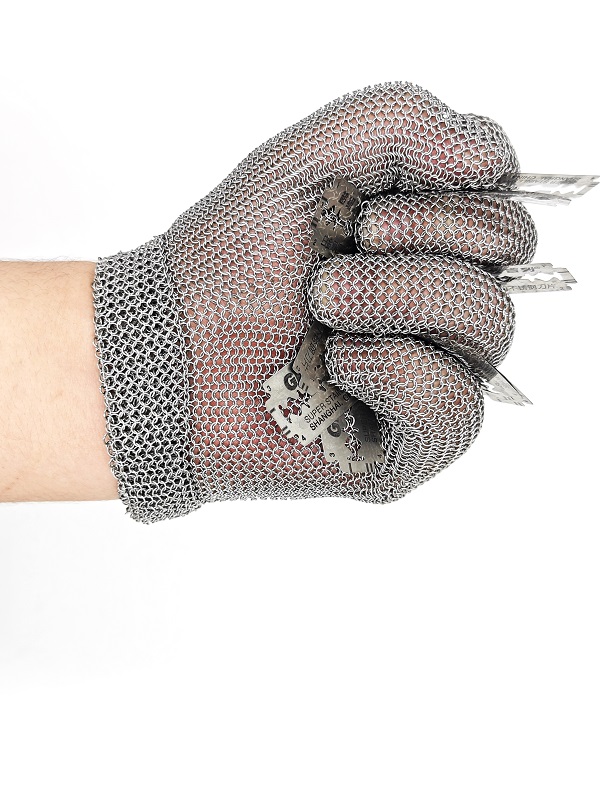
Stainless Steel Protective Mesh Gloves
Q: How do I determine the correct ANSI cut level for my operation?
A: The required level depends on the sharpness of the blade or edge and the force involved in the task. A risk assessment is the first step. Reputable manufacturers can provide guidance based on your specific tools and materials.
Q: Are these gloves machine washable?
A: Yes, a key advantage of stainless steel is ease of cleaning. Most professional-grade gloves can be washed in industrial dishwashers or autoclaved, which is essential for maintaining hygiene in food and medical applications.
Q: Can the gloves be customized?
A: Yes, manufacturers with strong OEM capabilities, like RETON RING MESH, can often accommodate requests for custom sizing, specific liner materials, and branding for large-volume orders.
Q: What is the typical lead time for a container order?
A: Lead times vary by manufacturer and order size. Established suppliers will provide a clear production schedule upon quotation. A typical lead time can range from 30 to 60 days, including production and shipping preparation.
Selecting the right stainless steel protective mesh glove is a technical decision that impacts workplace safety, compliance, and operational efficiency. Partnering with a manufacturer that demonstrates a clear command of materials, construction, and application-specific challenges is crucial.
If your organization requires reliable, professionally manufactured stainless steel protective mesh gloves, we invite you to connect with our team.
Contact RETON RING MESH for a technical consultation or to request product samples for evaluation.
E-Mail: sales@rt-ringmesh.com
WhatsApp: +86 186 3219 2156
Processing Demand Survey