
RETON Ring Mesh Co., Ltd.A Professional, Reliable And Experienced Metal Products Manufacturer
+86-18632192156 sales@rt-ringmesh.com

In industrial environments where sharp edges, metal burrs, and blades are constant hazards, hand protection moves beyond basic safety into a critical operational requirement. Stainless steel cut resistant gloves represent a specialized category of personal protective equipment (PPE) designed to provide a high level of defense against laceration and puncture injuries. Constructed from interlocking rings of stainless steel, often in a chainmail glove or metal mesh glove format, these gloves are engineered for scenarios where standard fabric or coated gloves are insufficient.
This guide provides a detailed, technical examination of stainless steel cut proof gloves, their applications, performance standards, and selection criteria. It is designed for safety managers, procurement specialists, and operators in industries ranging from metal fabrication and glass handling to food processing and automotive manufacturing.
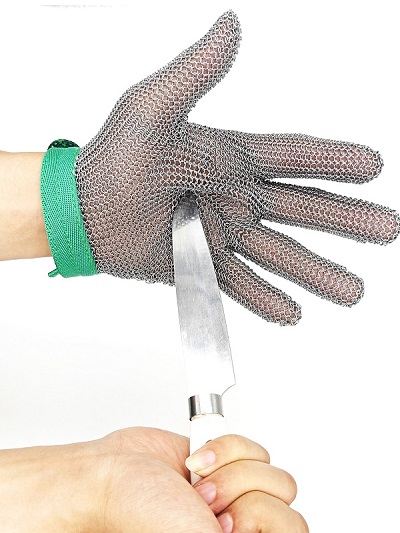
The performance of a stainless steel safety glove begins with the alloy. The most common grades used are:
AISI 304 Stainless Steel: Offers good general corrosion resistance and durability. A cost-effective choice for many industrial applications not involving harsh chemicals or chlorides.
AISI 316L Stainless Steel: Contains molybdenum, enhancing its resistance to pitting and corrosion from chlorides, acids, and saline environments. This makes it the preferred grade for food industry stainless steel gloves, chemical processing, and marine applications.
Specialty Alloys: Some manufacturers offer gloves made from hardened or specialized stainless steels for enhanced durability in extreme wear scenarios.
The method of construction significantly impacts protection, flexibility, and weight.
Ring Connection Types:
Riveted: Individual rings are connected with a small metal rivet. This creates a very strong, fixed connection that offers high puncture and cut resistance, but may reduce flexibility slightly.
Welded: Rings are fused at the closure point using welding technology. Provides a smooth, snag-free surface and good balance of strength and flexibility.
Butted (Closed): Rings are simply closed without riveting or welding. This method offers the greatest flexibility but provides the lowest level of protection, as rings can be forced open under high pressure.
Weave Patterns: The arrangement of rings (e.g., European 4-in-1, Japanese 6-in-1) affects the density, drape, and protective quality of the steel mesh glove.
Integrated Liners: Many models feature sewn-in liners made of materials like cotton, Kevlar®, or leather for comfort, moisture absorption, and an additional layer of abrasion resistance.
Palm Coatings: Some gloves have polymer (e.g., nitrile, latex) dots or full palm coatings to improve grip on oily or wet tools and materials.
Gauntlet Styles: Options range from short cuffs to extended gauntlets that protect the wrist and forearm. Gauntlets may be made of matching mesh, cut-resistant fabric, or durable leather.
To objectively compare gloves, it is essential to understand the international safety standards that govern cut resistance. For stainless steel industrial gloves, the most relevant are EN 388 and ANSI/ISEA 105.
This standard tests for abrasion, cut, tear, and puncture resistance. The most critical metrics for stainless steel mesh are:
| Symbol | Test | Performance Levels (1-4 or A-F) | Relevance to Stainless Steel Gloves |
|---|---|---|---|
| c | Cut Resistance (Coupe Test & TDM) | A (lowest) to F (highest) | The TDM test (ISO 13997) is most applicable, using a straight blade under increasing load. Quality stainless mesh gloves typically achieve Level D, E, or F. |
| p | Puncture Resistance | 1 (lowest) to 4 (highest) | Measures resistance to a standard stylus. Stainless steel gloves commonly achieve Level 3 or 4. |
This standard uses a different scale for cut resistance.
Cut Resistance (A1-A9): Tested via the ASTM F2992-15 (TDM-100) method. Stainless steel cut resistant work gloves often fall within the A6 to A9 range, indicating high to very high cut resistance.
Puncture Resistance (P1-P5): High-quality stainless mesh typically achieves P3 to P5.
Technical Insight: It is important to note that while stainless steel mesh offers exceptionally high cut and puncture resistance, no glove is "cut-proof." Protection is about risk reduction. The force, sharpness, and angle of contact all influence the outcome.
Stainless steel cut resistant gloves are deployed in industries where the cost of a hand injury is high, both in human and financial terms.
| Industry | Specific Applications | Key Glove Requirements |
|---|---|---|
| Metal Fabrication & Stamping | Handling sheet metal, blanks, stamped parts, and machined components with sharp edges and burrs. | High cut/puncture level (EN D-F / ANSI A7-A9), good dexterity, often a protective coating on the palm for grip. |
| Glass & Mirror Manufacturing | Handling large sheets of glass, cutting, edging, breaking, and packaging. | Maximum cut resistance (EN F / ANSI A9), extended gauntlets for forearm protection, smooth outer surface to prevent glass scratching. |
| Food Processing (Butchery, Filleting) | Boning, trimming, and cutting meat, poultry, and fish. Handling bones and shells. | Food-grade stainless steel (316L), easy to clean and sanitize, good balance of protection and knife-handling dexterity. |
| Automotive & Aerospace | Handling composite materials (carbon fiber), sharp engine components, and interior trim parts. | High dexterity for intricate tasks, protection against specialized sharp materials. |
| Recycling & Waste Management | Sorting and handling metallic scrap, broken glass, and other sharp debris. | Extreme durability, high cut/puncture resistance, often used as an over-glove. |
Selecting the correct glove involves a systematic risk assessment and matching glove properties to task requirements.
Identify the Sharp Hazard: Is it a slicing blade (knife), a puncturing point (needle, bone), or an abrasive edge (sheet metal)?
Evaluate Force and Frequency: What is the potential force involved in contact? Is it a repetitive task or an occasional handling risk?
Dexterity Needs: Does the task require fine motor skills (e.g., assembling small parts) or is it a general handling task?
Environmental Conditions: Are oils, chemicals, or extreme temperatures present? 316L stainless steel offers better chemical resistance.
Grip Requirements: Is there a need for enhanced grip on slippery tools or materials?
Based on the assessment, create a specification list. For example:
*"Require a stainless steel glove with EN 388:2016 rating of at least Level E cut resistance and Level 3 puncture resistance, with a nitrile-dotted palm for grip in an oily metalworking environment."*
As a manufacturer with a focus on metal mesh safety products, RETON offers gloves tailored to different needs.
| RETON Series | Target Application | Key Features | Typical EN 388 Rating (Cut/Puncture) |
|---|---|---|---|
| Industrial Pro Series | General metalworking, glass handling, fabrication. | 304 or 316SS, riveted/welded construction, leather or fabric palm. | E / 3 |
| Food Processing Series | Meat/poultry/fish processing, butchery. | 316L stainless steel, easy-clean design, food-safe. | E / 4 |
| High Dexterity Series | Automotive assembly, electronics, detailed work. | Finer mesh pattern, welded rings for smooth finish. | D / 3 |
Proper maintenance is crucial for hygiene and extending service life.
Daily/Post-Use Cleaning: Rinse under warm water to remove debris. Use a mild detergent and a soft brush for tougher grime.
Sanitization: For food-grade applications, immerse in or spray with a food-safe sanitizer solution.
Drying: Air-dry thoroughly in a well-ventilated area. Never store stainless steel gloves while damp, as even stainless steel can show surface discoloration or corrosion if constantly wet, especially lower-grade alloys.
Inspection: Regularly check for broken rings, stretched links, or damage to the lining. A single broken ring can compromise the protective barrier.
With proper care, a quality stainless steel cut resistant glove can last 12-24 months in industrial use. Replace gloves immediately if you observe:
Multiple broken or missing rings.
Significant stretching that creates gaps larger than the original design.
Corrosion that has pitted or weakened the rings.
Torn or worn-through lining that exposes skin to metal contact.
Q: Are stainless steel gloves comfortable to wear all day?
A: Modern designs prioritize ergonomics. While inherently heavier than fabric gloves, they are engineered with flexibility in mind. Proper sizing, integrated comfort liners, and articulated finger designs make them suitable for extended wear in high-risk tasks. The weight is a trade-off for the level of protection provided.
Q: Can these gloves be used with other PPE?
A: Yes. They are often worn as a standalone layer but can also be worn over a thin liner for comfort or under a chemical-resistant or temperature-rated over-glove for multi-hazard protection. Ensure the combination does not severely limit dexterity or cause bunching.
Q: How do I get the right size?
A: Measure the circumference of your dominant hand around the palm (excluding the thumb). Compare this measurement to the manufacturer's specific sizing chart. A proper fit is snug but allows for a full range of motion without excessive pressure.
Q: What's the difference between a "glove" and a "mitt" in stainless steel?
A: A glove has individual sheaths for each finger, offering greater dexterity. A mitt (often used in oyster shucking or meat cutting) encloses the four fingers together, providing more robust protection for the palm and fingers as a unit, which is often the primary contact point for a slipping blade.
Q: Why choose stainless steel over high-performance fiber gloves ?
A: It's a balance of priorities. Stainless steel mesh gloves generally offer superior puncture resistance and durability against abrasion. They are also easier to clean thoroughly and can withstand harsh sanitization. Fiber gloves are typically lighter and can offer very high cut resistance, but may be less effective against direct punctures and may have a shorter lifespan when exposed to sharp, abrasive edges.
Stainless steel cut resistant gloves are a specialized, high-performance solution for managing severe laceration and puncture hazards. Their effectiveness is rooted in material science, precise manufacturing, and adherence to international performance standards. By conducting a thorough workplace hazard assessment and selecting gloves that match the specific risks and task requirements, safety managers can significantly reduce hand injury rates.
Suppliers like RETON Ring Mesh Co., Ltd., which participate in the global industrial safety market, provide a range of engineered options. Their focus on different stainless steel grades and constructions allows businesses to source gloves that meet both safety and operational efficiency goals.
For detailed technical specifications, compliance certificates, or to discuss application-specific solutions for stainless steel cut resistant gloves:
RETON Ring Mesh Co., Ltd.
E-Mail: sales@rt-ringmesh.com
WhatsApp: +8618632192156
This guide is for informational purposes. Always conduct a site-specific risk assessment and follow all local regulations and manufacturer instructions for PPE use and care.
Processing Demand Survey