
RETON Ring Mesh Co., Ltd.A Professional, Reliable And Experienced Metal Products Manufacturer
+86-18632192156 sales@rt-ringmesh.com

Meat processing and slaughterhouse operations involve different manual cutting and handling tasks. Workers may use sharp knives when trimming meat, separating portions, deboning and preparing products.
During these operations, the chest, abdomen and upper thigh areas may also be exposed to accidental contact with sharp hand tools.
A Stainless Steel Mesh Apron for Meat Processing provides an additional protective barrier for these body areas. Made from interconnected stainless steel rings, the apron combines a flexible structure with cut and stab protection for suitable manual working environments.
Compared with ordinary fabric aprons, stainless steel mesh aprons are designed specifically for applications where contact with sharp edges and hand tools is a concern.
For meat processing facilities, choosing the right apron involves more than selecting a metal mesh product. Buyers should consider the coverage area, material, dimensions, strap design, cleaning requirements and intended working conditions.
A Stainless Steel Chainmail Apron is a protective garment made from interconnected metal rings. The ring mesh structure forms a flexible protective surface that can cover selected parts of the body.
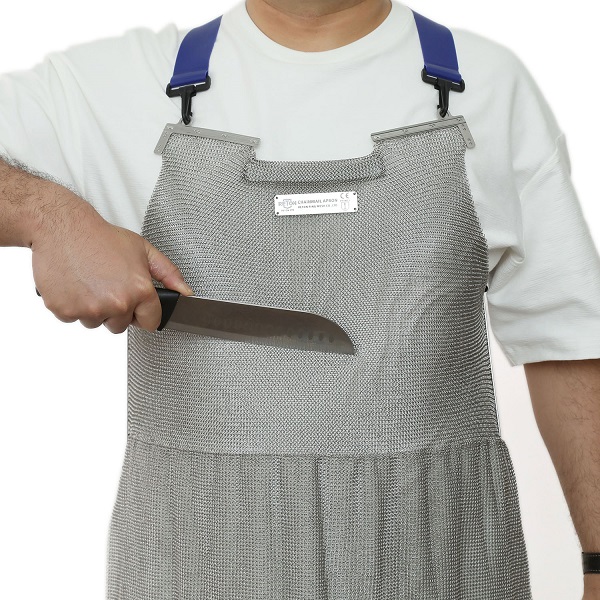
RETON's stainless steel mesh apron is designed to provide protection against cuts and stabs in the chest, abdomen and upper thighs.
Its main product features include:
100% stainless steel construction
Flexible and durable ring mesh structure
Adjustable straps for a more customized fit
Multiple size options
Custom dimensions available according to customer requirements
Suitable for selected food processing and industrial applications
The interconnected rings allow the apron to move with the wearer while maintaining a protective mesh surface.
For buyers sourcing protective equipment in bulk, understanding these construction details helps when comparing different chainmail apron products.
Meat processing workers perform manual trimming, cutting and preparation tasks throughout production.
A stainless steel butcher apron can provide additional protection for the torso and upper thigh areas when workers use suitable hand-operated cutting tools.
Typical applications include:
Meat trimming
Manual deboning
Meat portioning
Butchery operations
Meat preparation areas
The apron should be selected according to the cutting direction, working position and exposed body areas.
Slaughterhouse employees may handle sharp knives during different processing stages.
A chainmail apron can be considered when the workplace risk assessment identifies a need for additional torso protection during suitable manual operations.
The apron dimensions should provide appropriate coverage without unnecessarily restricting movement.
Fish and seafood processing may involve sharp knives, fish bones and other sharp materials.
Depending on the task, a metal mesh apron can provide additional protection for the chest and abdomen.
Buyers should evaluate the apron material and cleaning requirements according to the facility's hygiene procedures and working environment.
Poultry processing facilities involve cutting, trimming and preparation activities.
A stainless steel mesh apron may be considered for selected manual cutting tasks where additional body coverage is required.
The appropriate product should be determined by the actual operation rather than by industry category alone.
Stainless steel mesh aprons are also listed for selected garment manufacturing, cloth cutting and leather processing applications.
Workers handling sharp manual cutting tools may require additional protection around the torso and upper legs.
The apron size and coverage should be matched to the cutting position and the materials being handled.
Apron dimensions directly affect the area covered during work.
A product that is too small may leave exposed areas, while an oversized apron may be less comfortable during repeated movements.
RETON lists several standard stainless steel mesh apron dimensions, including:
| Apron Size | Typical Selection Consideration |
|---|---|
| 55 × 60 cm | A more compact coverage option |
| 60 × 80 cm | A larger coverage option |
| 60 × 55 cm | Another listed product configuration |
| 70 × 55 cm | An alternative coverage dimension |
| 80 × 60 cm | A larger listed configuration |
Other dimensions can be discussed according to customer requirements.
Before ordering, buyers should consider:
The worker's body measurements
Required chest and abdominal coverage
Whether upper thigh protection is needed
The working posture and movement range
The type of manual cutting operation
For wholesale orders, confirming the required size distribution and product dimensions before production can help avoid unnecessary adjustments later.
Material selection is an important consideration when purchasing a stainless steel chainmail apron.
The stainless steel grade can affect corrosion resistance and product performance under different working and cleaning conditions.
RETON lists a 316L stainless steel mesh apron configuration.
316L stainless steel is commonly selected for applications requiring good corrosion resistance.
For food processing environments, buyers may consider this material because of its suitability for wet working conditions when properly maintained.
Important purchasing considerations include:
Stainless steel grade
Ring construction
Corrosion resistance requirements
Cleaning and disinfection procedures
Compatibility with the facility's hygiene management system
The material specification should be confirmed for the exact product model before placing an order.
A protective apron must remain properly positioned during work.
The strap system helps support the apron on the body and allows adjustment for different users.
RETON's listed apron configuration includes adjustable straps, while its 316L stainless steel apron option features fully encased plastic straps designed to improve cleanability and reduce bacterial retention.
When comparing apron designs, buyers should consider:
The strap system should allow the wearer to adjust the apron according to body size and preferred wearing position.
In food processing facilities, straps and fastening areas should be considered as part of the overall cleaning procedure.
A design with accessible surfaces and suitable materials may make routine cleaning easier.
The apron should provide the required coverage without unnecessarily restricting movement.
Before bulk purchasing, it is useful to evaluate the fit and wearing experience with a sample.
Different aprons serve different purposes. A conventional fabric apron and a stainless steel chainmail apron should not be treated as interchangeable products.
| Comparison | Stainless Steel Mesh Apron | Ordinary Fabric Apron |
|---|---|---|
| Main material | Interconnected stainless steel rings | Fabric or synthetic materials |
| Main purpose | Protection against selected cuts and stabs | General clothing and surface protection |
| Structure | Metal ring mesh | Woven or coated material |
| Flexibility | Flexible metal mesh | Depends on fabric and coating |
| Cleaning | Requires product-specific cleaning procedures | Depends on material and coating |
| Typical application | Selected manual cutting environments | General food preparation and workwear |
A stainless steel mesh apron is designed for specific cutting hazards. It does not replace all other protective clothing or workplace safety measures.
In meat processing and slaughterhouse environments, workers may need protection for both hands and the torso.
A stainless steel apron and chainmail gloves can be considered together when the workplace risk assessment identifies exposure in these areas.
Stainless steel mesh gloves are designed for suitable manual cutting tasks involving sharp knives.
RETON offers different configurations, including:
Five-finger short gloves
Short gloves with textile straps
Short gloves with plastic straps
Short gloves with spring straps
Long stainless steel mesh gloves
Explore Stainless Steel Mesh Gloves to compare available designs.
The apron provides additional coverage for the chest, abdomen and upper thigh areas.
When purchasing gloves and aprons together, buyers should confirm that each product is suitable for its intended task and that the equipment works with the facility's overall safety procedures.
A combined order can also help distributors and food processing companies coordinate their protective equipment sourcing.
Regular cleaning and inspection are important for protective equipment used in food processing environments.
Because chainmail aprons contain many interconnected rings, cleaning should cover the entire mesh surface, straps and fastening areas.
Use the cleaning agents, water temperature and disinfection procedures recommended for the specific product.
Avoid assuming that all stainless steel products can be cleaned using the same process.
Before use, check for:
Broken or missing rings
Deformed mesh sections
Damaged connections
Loose or damaged fastening components
If damage is found, remove the apron from service until it has been assessed and repaired or replaced according to the manufacturer's instructions.
The straps should remain secure and adjustable.
Damaged straps or fastening components may affect the apron position and should be addressed before further use.
After cleaning and drying according to the manufacturer's instructions, store the apron in a designated clean area.
Proper storage helps protect the product from unnecessary damage and contamination.
For wholesalers, distributors and food processing companies, supplier evaluation is an important part of purchasing.
The following points can help buyers compare different products and suppliers.
Confirm whether the apron is made from the required stainless steel grade, such as 316L for the listed RETON configuration.
Specify the required dimensions and coverage area.
If standard sizes do not meet your needs, ask whether customized dimensions are available.
Check the strap material, adjustment structure and cleaning requirements.
Request the relevant product certificates and test documentation.
RETON's product page lists a CE certificate and states that the apron meets ANSI/ISEA Level 5 cut-resistance requirements. Buyers should request the supporting documentation and verify its applicability to the exact model and destination-market requirements.
Before ordering, confirm:
Individual product packaging
Carton quantity
Gross weight
Shipping dimensions
Minimum order quantity, if applicable
Delivery requirements
These details help importers estimate transportation and inventory costs.
RETON Ring Mesh Co., Ltd. offers stainless steel ring mesh products for different protective equipment applications.
Its stainless steel mesh apron range includes product configurations with:
100% stainless steel construction
316L stainless steel options
Adjustable straps
Multiple standard dimensions
Customized size options
Applications in meat processing, slaughterhouses, seafood processing and other selected industries
For wholesalers, distributors and industrial buyers, RETON provides product information to help compare apron sizes, materials and configurations.
If you are sourcing stainless steel mesh aprons, chainmail butcher aprons or related protective equipment, contact RETON with your preferred dimensions, material requirements and estimated order quantity.
A stainless steel mesh apron is designed to provide protection against cuts and stabs in selected body areas, including the chest, abdomen and upper thighs. It is commonly considered for suitable manual cutting tasks in meat processing and other industries.
RETON lists several standard dimensions, including 55 × 60 cm and 60 × 80 cm. Other configurations are also listed, and customized dimensions can be discussed according to customer requirements.
316L stainless steel offers good corrosion resistance and is used in various wet and hygiene-sensitive environments. The exact product should still be cleaned and maintained according to the manufacturer's instructions and facility requirements.
Yes. RETON lists customized size options. Buyers should provide their required dimensions and coverage expectations when requesting a quotation.
No. A chainmail apron is designed for selected cut and stab hazards. It does not provide universal protection against all workplace risks and should not replace task-specific risk assessment or other required protective equipment.
No. Stainless steel mesh aprons are not designed for chainsaws, band saws, circular saws or other powered cutting machinery. Metal mesh can become caught in moving equipment and create serious injury risks.
Yes. RETON offers both stainless steel mesh gloves and aprons. Buyers can discuss their required product combinations, dimensions and quantities when requesting a quotation.
Choosing the right stainless steel mesh apron for meat processing requires attention to material, dimensions, body coverage and strap design.
For importers, distributors and industrial users, confirming these details before ordering can help ensure that the selected product matches the intended manual cutting application.
Contact RETON Ring Mesh to discuss your requirements for stainless steel chainmail aprons and protective mesh gloves.
Hot Tags: stainless steel mesh apron, stainless steel chainmail apron, metal mesh apron, chainmail protective apron, stainless steel butcher apron, meat processing protective apron, slaughterhouse apron, 316L stainless steel apron, adjustable chainmail apron, wholesale stainless steel mesh apron
Processing Demand Survey