
RETON Ring Mesh Co., Ltd.A Professional, Reliable And Experienced Metal Products Manufacturer
+86-18632192156 sales@rt-ringmesh.com

How to make chainmail butcher gloves is a common question among manufacturers, safety equipment buyers, and industrial professionals. These gloves, also known as stainless steel chain mesh gloves, are designed to provide reliable cut protection in meat processing, fish handling, and industrial cutting environments.
Unlike general chainmail products, butcher chainmail gloves require stricter hygiene standards, precise ring construction, and consistent mesh integrity. This guide focuses on a practical, production-oriented approach to making steel chain mesh gloves, with technical insights, comparison tables, and FAQs—while avoiding repetition from general manufacturing overviews.
Before learning how to make them, it’s important to understand their structure.
A stainless steel chain mesh glove is made of thousands of small interlinked metal rings forming a flexible protective fabric. The design must balance:
Cut resistance
Flexibility
Hygiene (food-grade compliance)
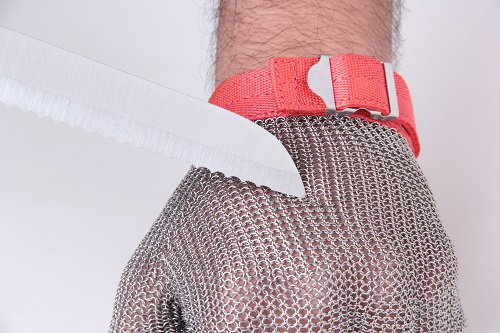
4-in-1 ring pattern (industry standard)
Welded or riveted rings for strength
Ergonomic glove shaping
Choosing the right materials is critical for both safety and durability.
| Component | Specification | Purpose |
|---|---|---|
| Stainless steel wire | 304 or 316L grade | Corrosion resistance, food safety |
| Wire diameter | 0.45–0.55 mm | Strength and flexibility balance |
| Ring inner diameter | 3.0–3.8 mm | Mesh density control |
| Fastening strap | TPU or metal buckle | Secure wrist fit |
Note: Food-grade stainless steel is required for butcher applications to prevent contamination.
The process starts with stainless steel wire:
Wire is straightened and cleaned
Surface must be smooth and free of defects
Consistent diameter is critical for uniform rings
The wire is wound into coils and cut into individual rings.
Automatic coiling machines ensure uniform size
Rings are cut with minimal burrs
Consistency affects final glove quality
Unlike decorative chainmail, butcher gloves require welded rings.
Micro-welding ensures each ring is closed
Prevents ring separation during cutting tasks
Improves overall safety performance
Rings are interlinked into a mesh structure.
Standard: 4 rings connected to 1 ring
Assembly can be semi-automated
Pattern must remain consistent across the glove
The flat mesh is shaped into a glove:
Finger sections are formed individually
Palm and back areas are aligned
Thumb positioning is critical for usability
Final shaping includes:
Smoothing edges to avoid skin irritation
Adding adjustable wrist straps
Ensuring proper glove fit
Since these are butcher gloves, hygiene is essential:
Ultrasonic cleaning removes residues
Surface polishing improves smoothness
Gloves are sanitized before packaging
| Parameter | Typical Value |
|---|---|
| Material | Stainless Steel 304 / 316L |
| Wire Diameter | 0.45–0.55 mm |
| Ring Diameter | 3.0–3.8 mm |
| Mesh Type | 4-in-1 |
| Glove Weight | 200–320 g |
| Hygiene Standard | Food-grade compliant |
| Cut Resistance | High (EN 1082-1) |
Different manufacturing approaches can be used depending on scale.
| Method | Description | Advantages | Limitations |
|---|---|---|---|
| Manual linking | Hand-assembled rings | Flexible, customizable | Slow production |
| Semi-automatic | Machine-assisted linking | Balanced efficiency | Moderate cost |
| Fully automated | Complete machine production | High output | Higher investment |
Butcher chainmail gloves have stricter requirements compared to general-purpose gloves.
| Feature | Butcher Gloves | General Chainmail Gloves |
|---|---|---|
| Material grade | Food-grade stainless steel | May vary |
| Ring welding | Required | Sometimes optional |
| Hygiene treatment | Mandatory | Not always required |
| Fit design | Ergonomic | Basic |
Uneven rings can cause weak spots in the mesh.
Poor welding may lead to ring failure under pressure.
Incorrect shaping affects comfort and usability.
Failure to meet food-grade standards can limit product use in the food industry.
Use high-precision wire drawing equipment
Maintain strict quality control at each stage
Regularly inspect welding integrity
Optimize mesh density based on application
These gloves are widely used in:
Meat cutting and slaughterhouses
Fish processing plants
Poultry processing
Industrial food preparation
Stainless steel 304 or 316L is commonly used due to its corrosion resistance and food safety properties.
Yes, for butcher gloves, welded rings are necessary to ensure safety during cutting operations.
Yes, but manual production is slower and less consistent compared to machine-assisted methods.
Depending on the method, it can take from several minutes (automated) to several hours (manual).
Yes, they are designed for long-term use with proper cleaning and maintenance.
Flexibility depends on ring size, wire thickness, and mesh pattern.
When manufacturing stainless steel chain mesh gloves, engineers must balance:
Ring density → improves protection
Wire thickness → increases durability
Glove weight → affects user comfort
An optimized design ensures that the glove provides reliable protection without restricting hand movement during precision tasks.
Understanding how to make chainmail butcher gloves requires attention to material selection, ring construction, welding quality, and hygiene standards. Unlike general chainmail products, these gloves must meet strict safety and food-grade requirements.
By following a structured manufacturing process and maintaining consistent quality control, producers can deliver reliable steel chain mesh gloves suitable for demanding industrial and food processing environments.
Processing Demand Survey