
RETON Ring Mesh Co., Ltd.A Professional, Reliable And Experienced Metal Products Manufacturer
+86-18632192156 sales@rt-ringmesh.com

In the high-pressure, fast-paced environment of professional kitchens, where razor-sharp blades move at lightning speed and hours of repetitive cutting create prime conditions for accidents, hand safety has become a critical concern. Chainmail gloves for cooking represent a specialized adaptation of medieval armor technology, engineered specifically for culinary professionals who face the unique combination of sharp edges, wet conditions, and the need for unimpeded dexterity. Unlike industrial versions, culinary chainmail gloves balance protection with the sensory feedback and flexibility essential for precision knife work.
This guide explores why serious chefs worldwide are incorporating these specialized gloves into their daily practice, how to select the right type for specific kitchen roles, and what technological advancements make modern culinary chainmail a practical tool rather than a cumbersome safety requirement.
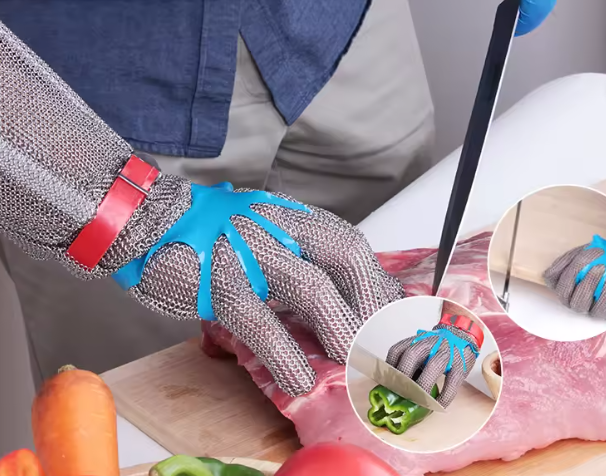
Professional kitchens report hand and finger injuries at rates significantly higher than most manufacturing environments. According to hospitality industry safety data:
65% of kitchen injuries involve knives or other sharp tools
Fingers and hands account for nearly 40% of all reported kitchen injuries
The average kitchen injury results in 5-7 days of lost work time
Repetitive stress from hours of cutting increases accident probability exponentially
Chefs face unique requirements that industrial gloves cannot address:
Sensory feedback must be maintained for delicate tasks like filleting fish or trimming meat
Moisture resistance is crucial in constantly wet environments
Heat tolerance near stoves and ovens is necessary
Hygiene standards exceed most industrial requirements
Flexibility and weight affect performance through 8-12 hour shifts
| Kitchen Role | Primary Cutting Tasks | Recommended Chainmail Type | Key Features Needed |
|---|---|---|---|
| Butcher/Meat Fabricator | Breaking down primal cuts, boning, trimming | Full five-finger stainless steel with reinforced palm | Maximum cut resistance, wrist protection, easy-cleaning surface |
| Fishmonger/Seafood Chef | Filleting, shucking, deboning small fish | Fine-gauge titanium or nickel-plated stainless with flexible fingertips | Corrosion resistance, precise fingertip protection, saltwater tolerance |
| Vegetable/Prep Chef | High-volume slicing, dicing, julienning | Three-quarter finger or fingerless chainmail with breathable back | Lightweight design, ventilation, knuckle protection |
| Pastry Chef | Chocolate work, intricate fruit carving, delicate slicing | Ultra-fine stainless mesh gloves (0.6mm rings) or chainmail fingertip guards | Maximum dexterity, temperature-neutral material, non-snag surface |
| Line Cook/General Chef | Multi-purpose cutting, rapid service work | Hybrid chainmail/aramid gloves with partial coverage | Balance of protection and mobility, heat resistance, quick-donning design |
| Culinary Student | Learning fundamental techniques, varied practice | Cost-effective stainless with removable liner | Durable construction, easy maintenance, adjustable fit |
Stainless Steel Grades:
316 Marine Grade: Superior resistance to salt, acids, and chlorides (ideal for seafood)
304 Food Grade: Excellent general-purpose corrosion resistance
Nickel-Free Options: For chefs with metal sensitivities
Advanced Alternatives:
Titanium Alloy: 40% lighter than steel with equal strength
Polymer-Coated Steel: Reduces "metal-on-knife" noise and improves grip
Composite Materials: Chainmail panels integrated with cut-resistant fabrics
Ring Engineering:
Smaller Diameter Rings (3-4mm): Provide better dexterity for intricate work
Flat-Wire Construction: Redances snagging on knife handles
Welded vs. Riveted: Welded joints prevent organic matter accumulation
Articulated Knuckle Areas: Allow natural fist formation and grip variations
Tapered Finger Design: Prevents "clown glove" effect while maintaining protection
Ventilation Channels: Strategic openings reduce moisture buildup
Temperature-Regulating Liners: Wick sweat while maintaining thermal comfort
| Performance Metric | Standard Industrial Chainmail | Culinary-Optimized Chainmail | Impact on Kitchen Work |
|---|---|---|---|
| Weight per Pair | 450-600g | 250-400g | Reduces fatigue during long prep sessions |
| Water Absorption | High (metal only) | Low (with hydrophobic liners) | Maintains dry comfort in wet environments |
| Thermal Conductivity | High (gets hot/cold quickly) | Moderate (with thermal barriers) | Safer near heat sources, comfortable in coolers |
| Cleaning Time | 5-10 minutes (detailed scrubbing) | 2-5 minutes (quick sanitize) | Fits into tight kitchen cleaning schedules |
| Tactile Sensitivity | Low (thick materials) | Medium-High (thin, conforming fit) | Enables delicate tasks like deveining shrimp |
| Donning/Doffing Speed | 30-60 seconds | 10-20 seconds | Practical during rapid task switching |
Every chef operates somewhere on this spectrum, and the right glove matches their position:
Maximum Dexterity End (Pastry chefs, sushi masters)
→ Recommended: Finger guards or ultra-fine mesh gloves
→ Protection Level: Moderate (prevents serious injuries but not full-force cuts)
→ Best For: Precision work where feel is paramount
Balanced Approach (Most line cooks, sauté chefs)
→ Recommended: Hybrid gloves with chainmail on vulnerable areas
→ Protection Level: High for common injuries
→ Best For: General kitchen work with varied cutting tasks
Maximum Protection End (Butchers, fabricators)
→ Recommended: Full five-finger chainmail
→ Protection Level: Maximum (prevents nearly all cutting injuries)
→ Best For: Heavy butchery and high-risk cutting
When evaluating chainmail gloves for kitchen use, consider these practical tests:
The Onion Test: Can you safely and efficiently dice an onion?
The Herb Test: Can you chiffonade basil without crushing it?
The Protein Test: Can you trim silver skin or pin bones effectively?
The Endurance Test: Are your hands fatigued after one hour of use?
The Cleanability Test: Can blood or pigment be completely removed?
Immediate Rinse: After use, rinse under cool water to remove food particles
Enzyme Cleaner Soak: Use food-safe enzyme cleaner for protein residue
Brush Cleaning: Soft brush between rings (consider ultrasonic cleaners for professional kitchens)
Sanitizing Dip: Food-safe sanitizer solution (quaternary ammonium or approved alternative)
Drying: Air dry completely on designated glove rack—never store damp
Lemon Juice or Vinegar Soak: Removes mineral deposits and brightens metal
Baking Soda Paste: For stubborn stains without scratching
Link-by-Link Inspection: Check for broken rings or compromised welds
Strap and Closure Check: Ensure secure fit mechanisms function properly
Professional Sharpening Check: Some manufacturers offer inspection services
Liner Replacement: Swap out removable liners for hygiene
Re-calibration: Ensure gloves maintain proper fit and protection level
| Glove Type | Price Range (Professional Grade) | Expected Lifespan | Cost Per Service Hour* |
|---|---|---|---|
| Basic Stainless Five-Finger | $80-$150 | 2-3 years | $0.05-$0.10 |
| Titanium Alloy | $200-$350 | 4-5 years | $0.08-$0.12 |
| Hybrid Composite | $120-$220 | 3-4 years | $0.06-$0.11 |
| Specialized (Fish/Butcher) | $150-$300 | 3-5 years | $0.07-$0.13 |
*Based on 2,000 service hours annually
Average kitchen cut injury: $1,200-$3,500 (medical + lost productivity)
Severe tendon/nerve injury: $15,000-$50,000+ (surgery + rehabilitation)
Career-ending injury: Priceless (loss of livelihood)
Workers' compensation premium increase: 15-25% for three years post-incident
For a $200 pair of titanium chainmail gloves used daily for 3 years:
Total investment: $200
Potential injury prevented: Even one moderate injury avoidance saves $2,500+
Productivity maintenance: Consistent skilled work without fear of injury
Insurance benefits: Possible premium reductions for safety equipment adoption
While RETON Ring Mesh Co., Ltd. (Contact: +8618632192156, Email: sales@rt-ringmesh.com) is known for industrial applications, their manufacturing capabilities extend to culinary-grade chainmail. Key considerations when sourcing from manufacturers:
Culinary-Specific Customizations Available:
Food-grade coatings that won't contaminate if scratched
Extended sizing ranges for diverse hand types
Specialized patterns for different culinary traditions (e.g., Japanese vs. French butchery)
Color-coded options for kitchen hierarchy or department identification
Quality Markers for Culinary Products:
Smooth interior seams that won't irritate during extended wear
Reinforced high-wear areas specific to knife grips
Halo- tested edges that won't damage fine knife blades
Temperature-resistant components for oven-adjacent work
Q1: Will chainmail gloves damage my expensive knives?
A: Quality culinary chainmail uses rounded, smooth rings that minimize blade contact. While some minor cosmetic scratching may occur on softer steel knives, professional-grade cutlery (Rockwell 58+) shows minimal wear. The alternative—damaged chef's hands—is far more costly than potential blade wear.
Q2: How do I maintain knife sharpness while using protective gloves?
A: Use a slightly more obtuse edge angle (20-22 degrees instead of 17-19) and maintain regular honing. The gloves actually provide consistent feedback about your sharpening effectiveness—dull knives require more pressure, which you'll immediately feel through quality chainmail.
Q3: Can I wear these through an entire 10-hour shift?
A: Modern culinary chainmail weighs 40-60% less than industrial versions. With proper fit and occasional removal during non-cutting tasks, most chefs adapt within a week. Consider starting with 2-hour intervals and gradually increasing wear time.
Q4: Are there chainmail options for chefs with very small or large hands?
A: Yes, specialized manufacturers like RETON offer extended sizing (XXS-XXL) and can create custom patterns. The critical measurement is hand circumference at the widest point, not overall hand length.
Q5: How do I convince traditional chefs to adopt this safety equipment?
A: Frame it as a tool for consistency and confidence, not as criticism of skill. Highlight that even master sushi chefs in Japan—renowned for knife skills—increasingly use fingertip guards. Offer to let them test during low-pressure prep rather than service.
Q6: What's the protocol if a glove is damaged during service?
A: Immediately remove and replace. Keep a backup pair available. Most culinary-grade chainmail can receive temporary field repairs (closing a broken link) to finish a shift, but should receive professional repair before next use.
Q7: Do these gloves provide any protection against burns?
A: Minimal direct heat protection, but they can prevent reflexive drops of hot items if you're cut while handling them. For combined cut/heat protection, consider hybrid gloves with heat-resistant panels on the palm.
Q8: How do culinary chainmail gloves compare to the newer "cut-resistant" fabrics?
A: Chainmail provides consistent protection regardless of blade sharpness or angle, while fabric gloves degrade with washing and can be penetrated by very sharp blades with sufficient pressure. Chainmail also withstands kitchen cleaning methods better and provides more consistent performance over time.
Conduct a cutting risk assessment for each station
Educate staff on injury statistics and prevention benefits
Invite manufacturers for demonstrations and fittings
Address cultural resistance through respected kitchen leaders
Equip highest-risk stations first (butchery, fish, vegetable prep)
Gather feedback on fit, comfort, and workflow integration
Measure pre/post-implementation near-miss reports
Adjust types and sizes based on initial experience
Standardize equipment across all cutting stations
Integrate glove inspection into opening/closing checklists
Include maintenance in weekly cleaning protocols
Track injury rates and cost savings quarterly
Solicit chef feedback for product improvements
Stay informed about new materials and designs
Share success stories with other kitchens
Consider custom designs for unique kitchen needs
Shape Memory Alloys: Gloves that "remember" individual hand shapes
Nanocoated Surfaces: Permanent non-stick properties for easier cleaning
Biometric Integration: Sensors that monitor grip pressure and fatigue
Task-Specific Modularity: Interchangeable palm/finger components
Temperature-Adaptive Materials: Auto-regulating thermal properties
Augmented Reality Integration: Training systems with protected practice
Culinary-Specific Certifications: Beyond industrial standards
Ergonomic Rating Systems: Standardized dexterity measurements
Sustainability Standards: Recyclable materials and production methods
The adoption of chainmail gloves in cooking represents more than just injury prevention—it signifies a maturation of culinary professionalism that values long-term career sustainability alongside immediate performance. Just as athletes protect their bodies to extend their careers, chefs now have technology to protect their most valuable tools: their hands.
The modern culinary chainmail glove is not the cumbersome armor of medieval times but a precision-engineered tool that respects both the art of cooking and the reality of kitchen physics. From the fishmonger's fingertip guards to the butcher's full gauntlet, these specialized implements allow culinary professionals to practice their craft with confidence, knowing that a single slip doesn't risk their livelihood.
For kitchens considering implementation, the journey begins with acknowledging that even the most skilled hands deserve protection, and that true mastery includes working intelligently as well as skillfully. The question is no longer whether professional kitchens need hand protection, but which solution best balances safety, dexterity, and the unique demands of culinary work.
For kitchens ready to explore culinary-specific chainmail solutions, including custom configurations for specialized tasks:
Contact: RETON Ring Mesh Co., Ltd.
Phone/WhatsApp: +8618632192156
Email: sales@rt-ringmesh.com
Begin with a consultation and sample program to match the right protection to your kitchen's specific cutting profiles, staff needs, and operational flow.
Processing Demand Survey