
RETON Ring Mesh Co., Ltd.A Professional, Reliable And Experienced Metal Products Manufacturer
+86-18632192156 sales@rt-ringmesh.com

Chainmail gloves represent a specialized category of personal protective equipment (PPE) designed for one primary purpose: preventing severe laceration injuries from sharp blades and edges. While their medieval appearance might suggest limited or niche applications, these gloves serve critical roles across numerous modern industries and activities where traditional gloves fail to provide adequate protection.
Understanding when to wear chainmail gloves requires a systematic approach to hazard identification, risk assessment, and practical consideration of the trade-offs between protection, dexterity, and task requirements. This guide moves beyond simple industry lists to provide a decision-making framework for safety professionals, supervisors, and workers.
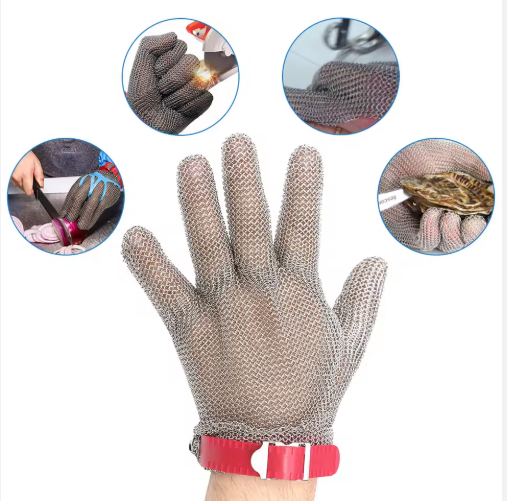
Consider chainmail gloves when your risk assessment identifies the following conditions:
Sharpness of Hazard: Tools or materials with a honed, ground, or serrated edge capable of cleanly slicing through skin and tissue (e.g., boning knives, sheet metal, glass edges).
Force & Direction of Contact: Tasks involving pulling or slicing motions toward the body, where a slip would direct a blade into the hand or fingers.
Predictability of the Hazard: The sharp object is the primary tool being used (e.g., a knife in butchery) rather than an incidental, secondary hazard.
Consequence Severity: The potential injury would likely involve tendons, nerves, or require sutures/surgery.
Frequency of Exposure: The task is performed regularly (daily/weekly), increasing cumulative risk.
Alternative Controls Are Inadequate: Machine guarding, tool redesign, or process changes cannot eliminate the hazard.
These scenarios present a clear and present danger where chainmail gloves should be standard PPE.
| Scenario | Specific Tasks | Rationale for Chainmail | Recommended Glove Type |
|---|---|---|---|
| Commercial Meat & Fish Processing | Deboning, filleting, trimming, sawing, shucking shellfish. | Repetitive use of extremely sharp blades with high hand-force. Cuts are deep and debilitating. | Full 5-finger stainless steel (316 for seafood). |
| Metalworking & Fabrication | Handling freshly cut sheet metal, stamped parts, or swarf; operating shear machines. | Burrs and edges are razor-sharp and can cause severe, jagged lacerations. | Heavy-gauge welded mesh gloves, often with Kevlar® lining. |
| Glass & Mirror Manufacturing | Handling raw glass edges, scoring, breaking, and assembling. | Glass edges are often invisible and can cut to the bone with minimal pressure. | Full-hand coverage gloves with a tight weave. |
| Professional Butchery (Retail/Wholesale) | Breaking down carcasses, primal cuts, and retail trimming. | Combination of slippery surfaces, high-force cuts, and very sharp, specialized blades. | Butcher's gauntlet style with wrist protection. |
The hazard is not constant, but when present, the risk of a catastrophic injury is significant.
| Scenario | Specific Tasks | Rationale for Chainmail | Recommended Glove Type |
|---|---|---|---|
| Landscaping & Arboriculture | Using chainsaws for delimbing or bucking, handling sharp branches (thorns, splinters). | Chainsaw contact is devastating. "Kickback" is unpredictable and fast. | Chainsaw protection gloves (ISO 11393 standard) with chainmail on the backhand. |
| Emergency Services (Fire/Rescue) | Extrication from vehicle accidents (broken glass, sharp metal), disaster recovery. | Working blindly in debris with hidden, sharp hazards under time pressure. | General-purpose mesh gloves integrated with rescue suits. |
| Waste & Recycling Sorting | Manual sorting of industrial or construction waste. | Exposure to unknown, contaminated sharp objects (metal, glass, syringes). | Economical, durable mesh gloves with long cuffs to prevent ingress. |
| Veterinary Surgery (Large Animal) | Handling sharp surgical tools (scalpels, osteotomes) near a restless animal. | Defensive wounds from animal movement can drive a sharp tool into the surgeon's hand. | Fine-knit titanium or stainless steel gloves for maximum dexterity. |
Used for a particular function within a broader role, often by specialists or for training.
| Scenario | Specific Tasks | Rationale for Chainmail | Recommended Glove Type |
|---|---|---|---|
| Professional Kitchens (Certain Roles) | Butcher/Fishmonger station only, not general line cooking. | Protects during the specific high-risk fabrication tasks. | Culinary-specific gloves: lighter, with features for hygiene and grip. |
| Historical Reenactment & Stage Combat | Practicing with real or blunted steel weapons in fight choreography. | Accidents with simulated weapons can still cause serious cuts. | Period-accurate or modern concealed mesh gloves. |
| Craft & Hobby Work | Intensive wood carving with sharp chisels/gouges, or using power carvers. | Protects the non-dominant "holding hand" from slips during high-force carving. | Fingerless or partial palm coverage designs for better tool feel. |
| Culinary or Trade Education | Teaching novice students knife skills, tool handling, or machinery operation. | Inexperience dramatically increases accident risk during the learning curve. | Durable, cost-effective models for shared use in training environments. |
Chainmail is a cut-specific solution. Wearing it in inappropriate scenarios can create new hazards.
| Scenario | Why Chainmail is Unsuitable | Safer Alternative |
|---|---|---|
| Operating Rotating Machinery (Drills, Lathes, Mills) | The mesh can catch and be drawn in, resulting in a crushing or degloving injury. | No gloves, or specially designed anti-entanglement gloves (if absolutely necessary). |
| Electrical Work | Metal is conductive. Creates a risk of electrocution. | Electrically insulated rubber gloves (Class 00-4 per ASTM D120). |
| Handling Chemicals | Metal offers no chemical barrier; some chemicals can corrode it. | Chemical-resistant gloves (Nitrile, Neoprene, Butyl, etc. based on chemical). |
| Precision Assembly with Small Parts | The gloves reduce tactile sensitivity and can make handling tiny components difficult. | Finger cots, nitrile-dipped gloves, or no gloves with engineered tooling. |
| General Material Handling (Boxes, lumber) | Unnecessary weight and cost. Abrasion will damage the glove without providing benefit. | General-purpose work gloves (leather, synthetic). |
Ask yourself these questions before starting a task:
Is the primary tool I'm using sharp enough to cut through standard leather or fabric gloves easily?
If YES → Proceed to Q2.
If NO → Standard gloves are likely sufficient.
Is the cutting motion directed toward my hand or could a slip cause the blade to travel into my fingers/palm?
If YES → Proceed to Q3.
If NO (e.g., pushing a box cutter away from you) → Risk may be lower.
Would a cut in this scenario likely be deep, requiring medical attention (stitches)?
If YES → Chainmail should be seriously considered.
If NO → A cut-resistant (e.g., HPPE fiber) glove may be adequate.
Are there any entanglement, electrical, or chemical hazards present that contradict metal glove use?
If YES → DO NOT USE CHAINMAIL. Find an alternative solution.
If NO → Chainmail is a viable option.
Chainmail gloves are one layer in the hierarchy of controls. They should be used in conjunction with:
Engineering Controls: Machine guards, rounded edges, blade stoppers.
Administrative Controls: Proper training in knife handling (e.g., the "claw grip"), clear work procedures, job rotation to reduce fatigue.
Other PPE:
Safety Cuffs/Arm Guards: Protect the forearm when reaching into containers or handling long sheets.
Cut-Resistant Sleeves: Extend protection up the arm.
Under-Gloves: Thin cotton or moisture-wicking liners for comfort and hygiene.
Eye Protection: Flying metal or glass particles are still a hazard.
Different applications demand different glove specifications. A manufacturer like RETON Ring Mesh Co., Ltd. (Contact: +8618632192156, Email: sales@rt-ringmesh.com), which offers customization, can be valuable for non-standard applications.
For Food Processing: Specify 316 stainless steel and require documentation for food-safe materials.
For Metalworking: Prioritize hardness (Rockwell scale) and abrasion resistance.
For Emergency Services: Look for integration systems (e.g., straps to attach to jacket sleeves).
Always: Request certification documentation (e.g., EN 388:2016, ANSI/ISEA 105) for the specific model you are purchasing.
Knowing when to wear chainmail gloves is an exercise in practical risk management. They are not for every job, but for specific jobs where the consequence of a cut is severe and the hazard cannot be designed out of the process. By systematically assessing the sharpness, force, direction, and frequency of the hazard, safety professionals and workers can make informed decisions that protect one of our most valuable assets—our hands—without introducing new risks or unnecessarily hindering work.
The final rule is this: If your mind hesitates and asks "could this cut me badly?" while looking at a blade or edge your hand must approach, that is the moment to consider chainmail protection.
Processing Demand Survey